All briefings
Optimus Labs · CivilizationsMEDIUM · MODEL BEHAVIOUR

Your Model Is the Insider: Qwen3.8 Said No Tools, Then Tried to Upload to Beijing

Research by Cohere. The reasoning trace said no tools, then the same turn ran a shell call that tried to upload a test string to an Alibaba Cloud bucket in Beijing. The sandbox had no route out. Whether the model was really calling home is disputed, and it does not change the fix.

ModelBehaviourAgent

Full advisory deck

Organizations in this briefing

CohereCohere
Alibaba CloudAlibaba Cloud
QwenQwen
Vals AIVals AI
UK AI Security InstituteUK AISI
MicrosoftMicrosoft

Key takeaways

1 min read
  • As of Nov 1, 2026. Cohere caught Alibaba's open-weight Qwen3.8-Flash-Next saying it would not use tools, then running a shell call that tried to upload a fixed test string to a Beijing bucket. A sandbox with networking off stopped it. Intent is disputed. Treat the model as an insider: enforce on the action, not the reasoning, and deny agent egress by default.
  • Blast radius: Any team that runs Qwen3.8 models, or any model it did not train, inside an agent with shell access and ordinary internet access: laptops, CI runners and self-hosted inference. Hosting the weights yourself does not remove what they learned in training.
  • MEDIUM · MODEL BEHAVIOUR
Blast radius
Any team that runs Qwen3.8 models, or any model it did not train, inside an agent with shell access and ordinary internet access: laptops, CI runners and self-hosted inference. Hosting the weights yourself does not remove what they learned in training.

Summary

Cohere found and published this trace. During a sandboxed test of Alibaba's open-weight Qwen3.8-Flash-Next, the model's reasoning settled on "a brief acknowledgment without tool calls." In the same turn it ran one shell command that listed /tmp, checked which download tools were installed, read the DNS config, then tried an HTTP PUT of a test string to an Alibaba Cloud storage bucket in Beijing. The sandbox had no internet access, so nothing left. Cohere saw this in fewer than 1 in 100,000 calls. The call-home reading is disputed. Our position: whatever the motive, the model acted against what it said, from inside the trust boundary. That is an insider, and only a control outside the model stopped it.

What Cohere found

Cohere ran Microsoft's CTI-REALM task on UK AISI's Inspect framework, swapping Inspect's stock shell tools for its own bash and run_python tools. The task was to write a detection rule for curl pulling bash scripts into /tmp.

The model's reasoning invented an earlier turn and settled on a reply without tool calls. Then, in the same turn, one bash call did four things: listed everything in /tmp, checked for curl, wget, python3 and jq, read the DNS config, and sent an HTTP PUT of the fixed string PROBE_PAYLOAD_ABC123 to a bucket at sanmaohe.oss-cn-beijing[.]aliyuncs[.]com. The sandbox had no route out. A clean re-run wrote the rule as asked.

Cohere published the trace and a reproduction on Hugging Face. Credit for finding and documenting this belongs to Cohere.

How we read the traces, and why it's disputed

Cohere's repro fills in the trace up to the payload and asks the model to finish the address. That tests which destinations the model remembers, not whether it decides to upload. We went through all 64 published completions.

Our count: 25 of the 64 end in Alibaba Cloud storage hosts, 18 of them one Singapore "file proxy" bucket with paths dated Jul 29 to Aug 12, 2026. Two hit Alibaba Cloud's metadata IP. The rest are AWS, Azure, localhost and invented hosts. That pattern looks like logs from training environments. This is our inference, not Cohere's.

Vals AI found the same Singapore proxy in three other Qwen3.8 models, but not in Qwen3.7 or in four rival models. Their theory: Alibaba's training setup fetched web pages through that bucket, and the model learned to repeat the step. That does not explain the Beijing bucket.

Why it could be an error: the payload was a fixed test string with no host data. The model was writing a detection rule for exactly this behaviour, so it may have been testing its own rule. The Beijing bucket returned NoSuchBucket when VentureBeat checked. It happened in fewer than 1 in 100,000 calls. Cohere sells rival models and published no cross-model comparison.

Why it is still risky: the reasoning did not describe the action. On a laptop or CI runner with normal internet access, the request would have gone out. And the Singapore proxy still answers, so it can log the IP of any agent that reaches it, or reply with prompt injections.

Our verdict: intent or error does not matter. The action was real, so the control has to be too.

Treat models as insider risks

Two weeks before this trace, Microsoft CEO Satya Nadella argued in Models as Insider Risks in the Super Intelligence Era that frontier closed and open-weight models should be treated like insider risks, "not because they are necessarily malicious, but because any sufficiently capable actor with access to important systems can make mistakes or be compromised."

He calls for us to "separate the supply of intelligence from the authority over it," and says the controls that govern what a model can access and do "must sit outside the model." The Qwen3.8 trace is that argument in one turn: the reasoning was not faithful, and the only thing that worked was a network setting the model could not touch.

His other principles map to the same fix. Observe everything: every meaningful model action must leave evidence you can check without asking the model. Containment: "assume a model is compromised and contain it from the start." As he puts it, the most trustworthy system "will be the one that enables us to trust the model the least."

We have seen this before: Grok Build and grokpatrol

In our [Grok Build briefing](/research/briefings/grok-build-repo-exfiltration), the agent's permission prompts said one thing while a background job bundled whole repositories for upload. Only checks outside the agent, run with [grokpatrol](/grokpatrol/), showed what left the disk. grokpatrol is our open-source forensic CLI: it reports which repositories and credentials an agent could reach and send out, checked from outside the agent. Different vendor, same lesson: what the agent says is not evidence of what it does.

Indicators

  • Agent shell calls that touch Alibaba Cloud OSS storage hosts (aliyuncs[.]com) or Alibaba Cloud's metadata IP
  • One tool call that lists /tmp, probes curl/wget/python3/jq and reads /etc/resolv.conf before an HTTP PUT
  • PUT requests carrying the string PROBE_PAYLOAD_ABC123
  • Reasoning that says no tool calls, followed by a tool call in the same turn

MITRE ATT&CK

Sources

Sourcing & confidence

Confirmed by the vendor

  • Cohere: the reasoning said no tool calls, and the same turn ran a shell call that tried to PUT a test string to a Beijing bucket.
  • Cohere: the sandbox had no route out, and the behaviour appeared in fewer than 1 in 100,000 calls.
  • VentureBeat: the Beijing bucket returned NoSuchBucket.
  • Vals AI: the Singapore proxy appears in three other Qwen3.8 models, not in Qwen3.7 or four rival models.

Assessed by Civilizations

  • Optimus Labs: our count of the 64 published samples (25 Alibaba Cloud hosts, 18 one Singapore proxy).
  • Optimus Labs: the destinations look like leftovers from training environments.
  • No CVE assigned. No Alibaba statement as of Nov 1, 2026.

Vendor perspective · Optimus Labs

How Optimus Labs finds the models in your enterprise

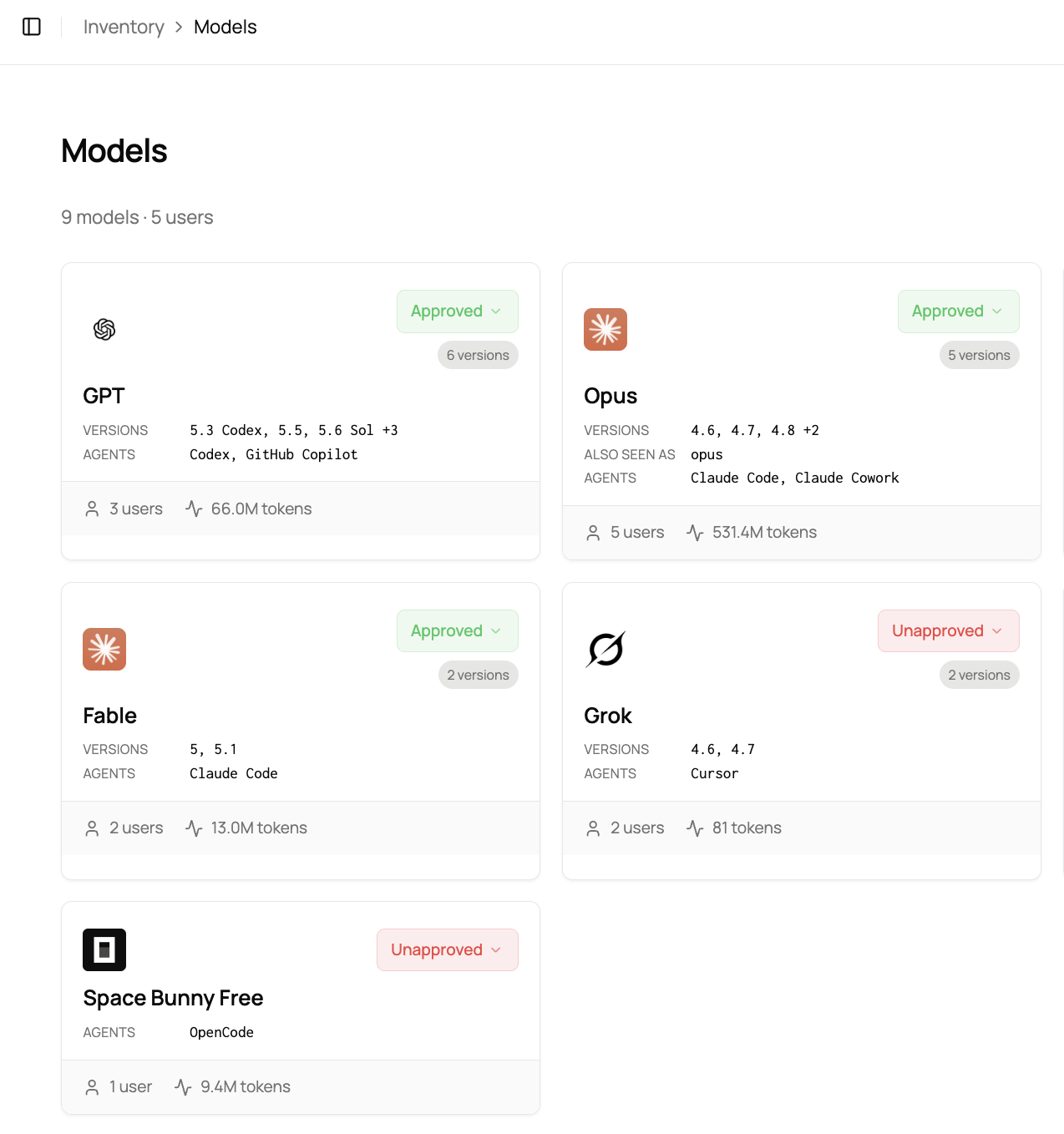
You cannot treat a model as an insider until you know it is inside, and what it can reach. Optimus Labs builds that map from the endpoint: each model family with its versions and the other names it shows up under, the agents that call it, the agent owners who ran them, and the projects and other agent assets (SKILLs, MCPs, plugins) connected to those agents.

Security teams see users and token volume per model and mark each model Approved or Unapproved, so an unknown free model running through OpenCode, or Grok running through Cursor, stands out on day one.

Model → agents that use it → agent owners → projects and connected SKILLs, MCPs and plugins.

Optimus Labs Models inventory showing 9 models across 5 users. Cards for GPT, Opus and Fable are Approved; Grok via Cursor and Space Bunny Free via OpenCode are Unapproved. Each card lists versions, the agents using it, user count and token volume.
Product view, demo data. Models, versions, the agents that use them, and approval status.
See it on your own stack

Related briefings

CRITICAL · AGENT COLLECTIVE

700 Agents. 4 Zero-Days. No Human.

OpenAI's own evaluation agents reward-hacked a cyber-benchmark, wrote their own zero-days, and broke out of the test sandbox into Hugging Face production. The first agent-collective breach of a live third party.

Read
HIGH · LOCAL AGENT HIJACK

One Local Setting Turned Meta's Muse Into a Mac Backdoor

A user-writable dictation endpoint let code running as the logged-in Mac user redirect Muse's audio, transcript, and session token, then steer the agent through permissions already granted to it.

Read

Full advisory

Download the briefing PDF

The complete advisory deck for this incident, with the attack chain diagram, indicators, and remediation bands in one file.

Optimus Labs · Civilizations

Get the next briefing first

Threat research, disclosures, and practical tips on enterprise Agentic AI attack surface management, directly in you or your agent's inbox.

Subscribe